Smart Paid Promotion for Spotify Artists
A product teardown and redesign proposal for Spotify's artist promotional tools. Focusing on a specific user, the independent artist running their first paid campaign, and identifying why most eligible artists never start.
The proposed solution is Smart Promo: a recommendation-driven system that acts as a proactive advisor, suggesting promotional campaigns at the right moment.
Product teardown
Context
Artists on Spotify can pay to promote their music through a set of tools housed inside Spotify for Artists (S4A).
The core paid products are Marquee (paid push notifications), Showcase (homepage placements), and Discovery Mode. Each has a distinct payment model, targeting logic, and UX flow.
M
Marquee
Full-screen sponsored recommendation shown to likely listeners when an artist releases new music. CPC (cost per click) model. Min. ~$100 budget.
S
Showcase
Homepage shelf placement for catalog/song promotion. CPC (cost per click) model . Targets active and lapsed listeners. Min. ~$100 budget.
D
Discovery Mode
Artists opt songs into algorithmic playlists in exchange for a royalty rate reduction on streams driven by Spotify. No upfront cost - revenue share model.
The problem: Spotify's promotional tools are crucial for attracting listeners, but the majority of artists don't use them
Artist personas
Spotify creators that are eligible for paid promotional tools can be categorised into 3 types.

The independent artist
Self-managed · 1k - 10K followers
The mid-tier small label / DIY artist
Self managed + team managed · 10k–500K followers

Label / manager operator
Team managed · multiple artists
For this project, I’m focusing on small independent artists, those releasing music without label support, because they represent a growing share of Spotify’s creator ecosystem, but are the least equipped to navigate its promotional tools.
Core pain points
Discovery happens too late. Artists find out the tools exist after the momentum has already peaked.
Complexity is a wall. Unlike established artists, independent artists don’t have dedicated marketing teams or clear playbooks. Promotion decisions are made individually, often with limited context or confidence.
The outcome is hard to understand. Results arrive as raw numbers with little context or benchmark. Artists can't tell whether the spend was worth it, so they don't come back.
The independent artist's journey through the current experience has five emotional states.
Interested
Intimidated
Anxious
Helpless
Unconvinced
Focusing on the 2nd stage of the journey, many independent artists are too intimidated to start running a campaign. They don't know which tool to use, when to do it, who the audience should be or how much money to spend. Spotify loses a potential customer. The artist loses a growth lever.
The opportunity this creates is precise:
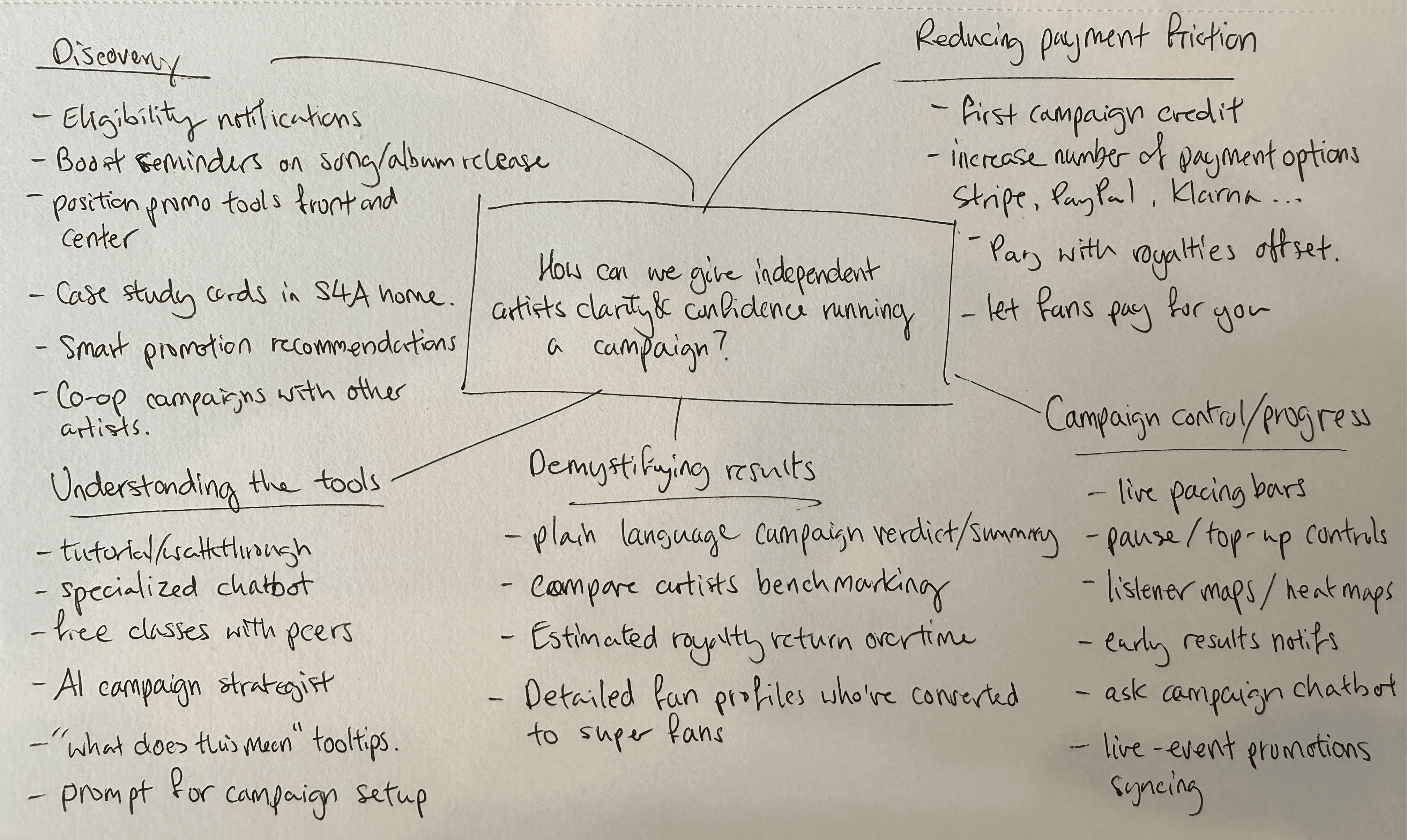
How might we give first-time independent artists enough clarity and confidence that they feel confident running a campaign?
Starting from Jamie's five journey moments, I generated 26 ideas across the spectrum from quick wins to moonshots.
Solution: Smart Promo
Smart Promo is a recommendation-driven promotional system built inside Spotify for Artists. Spotify stops waiting for artists to find and configure promotional tools and starts surfacing the right promotion at the right moment. Pre-configured, reasoned, and ready to launch with one tap.
The solution consists of 3 key layers: intelligent audience targeting, a recommendation engine, and single-tap launch. Spotify holds the intelligence and uses it to suggest the right campaign at the right moment.
01
Reach listeners by who they are, not just what they've previously played. Spotify generates 'taste graphs' to surface clusters like "late-night indie listeners" or "bedroom pop fans". The artist can also describe audiences in plain English; an AI maps it to a real Spotify segment with an estimated size shown upfront.
02
Recommendations fire when something real happens: a release, an upcoming show, a dip in monthly listeners, or an untapped city with high listener density. Each trigger generates a specific, reasoned suggestion with a plain-language hook.
03
When a recommendation arrives, the audience is already selected, the budget is pre-set based on listener size, and the campaign dates are configured around the triggering event. If the artist wants to adjust, it's three controls on a single screen. If they don't, it's one tap.
01 Intelligent audience targeting
The current targeting system asks the artist to choose between "lapsed listeners," "active fans," and "programmed audience". While these are useful categories, they can be difficult to understand and feel limiting for an independent artist.
The new targeting system combines the existing layers and 2 new targeting layers to create more specific and relevant campaign audiences.
Taste graphs
Intelligent audience targeting includes a new 'taste graph' layer that surfaces Spotify's internal listener clusters in terms that an artist recognizes. "Late-night indie listeners" or "90s rap fans" can be real segments. The artist selects from pre-suggested clusters based on their existing fanbase, or describes one in plain language and lets an AI model translate it.
Live event geo-targeting
Another new targeting layer is geographic and event-based. This works in two ways: listeners who have tickets for shows are more likely to listen to the artist, and existing listeners are more likely to buy tickets to a nearby show. Spotify can detect proximity to upcoming shows and reach listeners in the same city, reaching a specific but high ROI audience.
Existing layer
Who's already listened
Active fans, lapsed listeners, programmed audience.
NEW layer
Who's got the same taste
Derived from signals: listening context, playlists, mood selections, time-of-day behaviour.
NEW layer
Who's in the right place right time
Reach listeners who are in the radius of a venue days surrounding a show.
All 3 layers combine
Lapsed NYC listeners + late-night indie (taste graph) + 20-mile radius (geographic)
—> surfaced to artist as "8,200 listeners likely to come to your Brooklyn show."
Release signal
New release published or scheduled. Marquee is recommended within the 21-day eligibility window. High priority, fires immediately on publish.
Event signal
Upcoming show detected from Spotify's concert feature. Geo-targeted Showcase/Marquee recommended 7–10 days before and after show date. Budget pre-set based on local listener density.
Audience drift signal
Monthly listeners down more than 15% over 60 days. Lapsed-listener re-engagement Showcase recommended. Framed as a recovery opportunity, not an alarm.
02 Recommendation engine
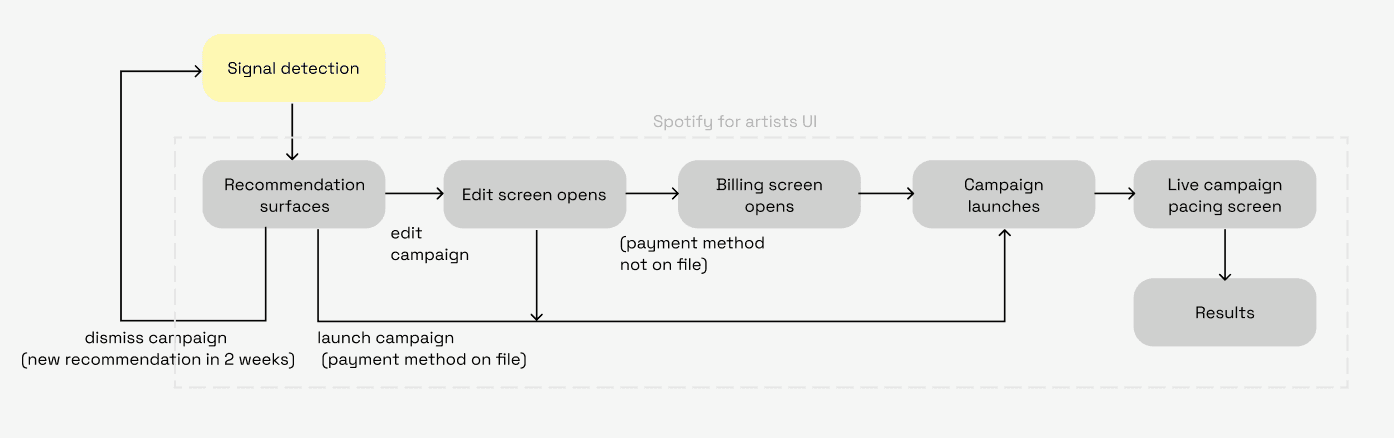
The initial MVP version of the recommendation engine monitors 3 signals continuously. When one fires, a pre-configured campaign recommendation surfaces on the S4A home feed. Each recommendation contains exactly what Jamie needs to decide: the promotional tool type, an audience breakdown, a budget, and a launch button. Nothing more.
03 Launch in one tap
I want the UX to have as few steps as possible, to minimise friction in starting a campaign.
When the artist taps "Launch" directly, there are no more decisions needed, and the campaign begins immediately.
When the artist taps "Edit" on a recommendation, the edit screen opens with more controls: audience chips, a budget slider, a date slider, and release selection.
The billing screen only opens if no payment method has been provided.
UI mocks
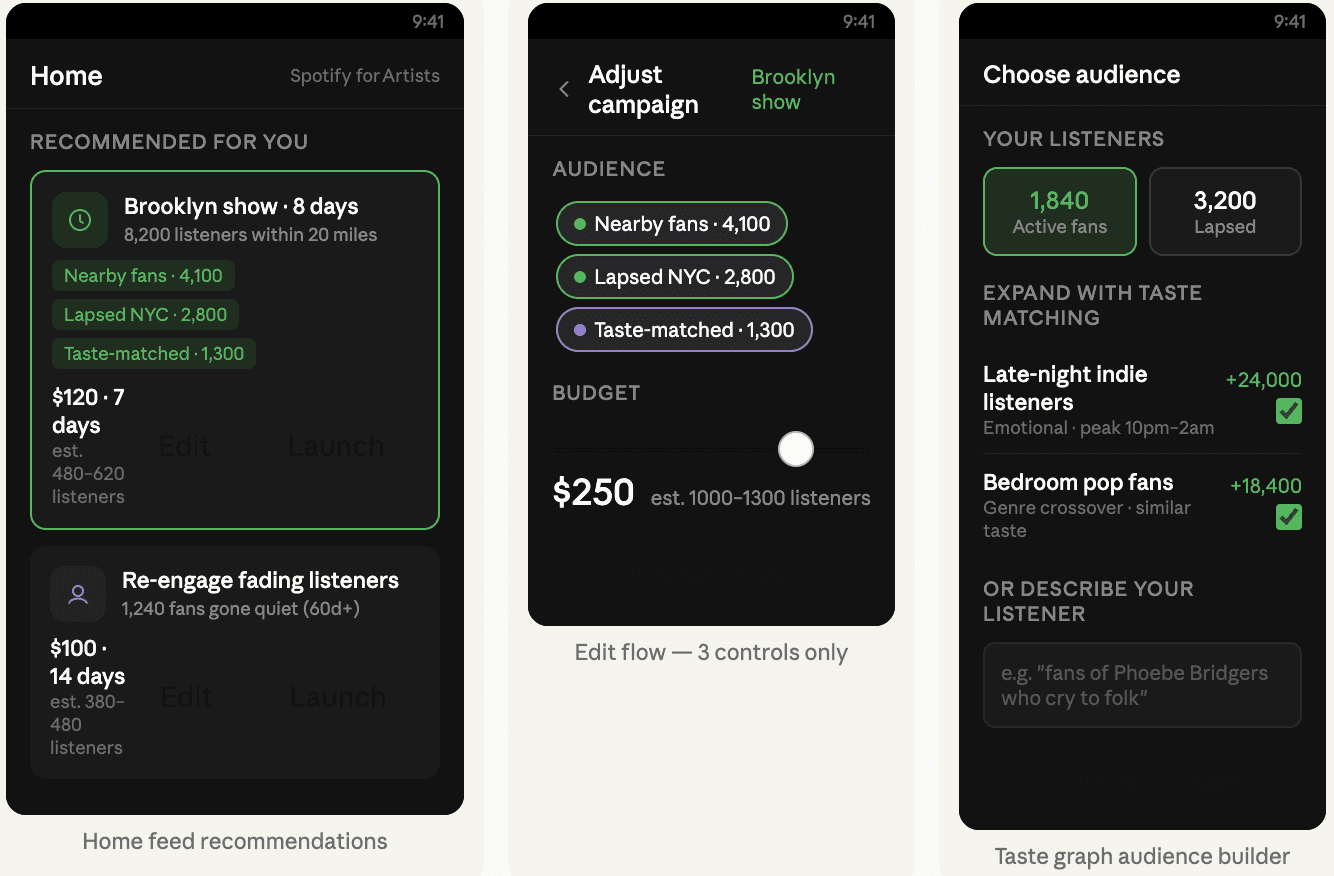
Campaign Recommendation and Editing
UI for recommendation, editing a campaign, and choosing an audience.
The artist is able to launch a campaign directly from a recommendation with one tap.
The edit flow provides additional control, should an artist need it.
Live Campaign
I added options to pause and add budget to an existing campaign, with the aim to empower artists to feel more in control throughout the experience.
The metrics surfaced in the results page focus on numbers that an artist would understand, including a summary of overall campaign performance.
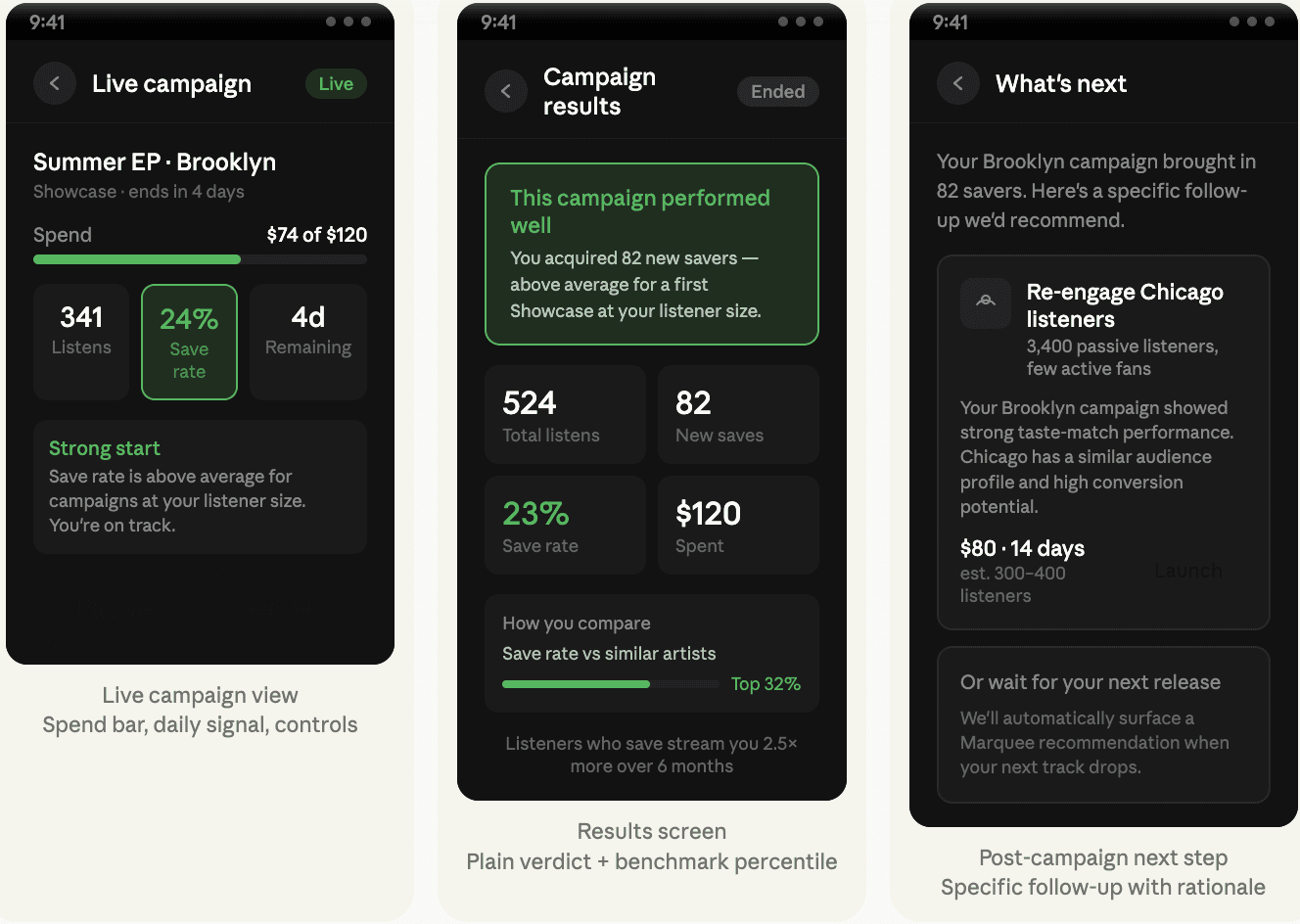
Metrics
The North Star Metric
Second campaign launch rate among first-time artists - the percentage of artists who ran their first Smart Promo campaign and went on to launch a second.
The north star is focused on value provided to the artist. It requires a deliberate financial recommitment that is only made when the artist perceives genuine value from Smart Promo. The one limitation to this metric is that it is a lagging metric. That's why the supporting metrics below matter.
Supporting metrics
These are the early-signal layer while the north star metric matures, plus the quality checks that ensure the campaigns we're driving are providing value.
Qualified activation rate -The percentage of artists who launch a first campaign within 14 days of that trigger firing.
Measures whether Smart Promo is successfully converting genuine promotional moments into first campaigns. Target: above 30%.
Set up completion rate from recommendation - percent of artists who engage with a Smart Promo recommendation that complete and launch.
Measures friction elimination in the flow from recommendation to launch. Target: above 65%.
Intent rate for first campaigns - Saves and playlist adds divided as a percentage of listeners reached.
Validates campaign quality and targeting. If this falls while activation rises, the product is generating premature campaigns for unready artists. Floor: above 15%.
Guard rail metrics
These metrics are to ensure the Smart Promo solution doesn’t have hidden problems or degrade other products.
Spend concentration by artist tier - percentage share of total Smart Promo campaigns from each artist category.
This is a direct measure of whether the product is serving its intended audience - the independent artist. Threshold: Independent artists must account for at least 50% of total Smart Promo campaign starts.
Promotional tool cannibalization rate - ratio of free promotional tool actions to Smart Promo campaign starts.
Ensures that free promotional tools are not being cannibalized in favour of paid smart promo tools. Spotify for artists should not be a pay-to-play platform, as that would erode trust. Threshold: free tool engagement must not decline by more than 20%
Budget utilization rate - percentage of the committed campaign budget delivered across all Smart Promo campaigns monthly.
Underdelivery is invisible to the artist in the moment, but compounds distrust quickly. Threshold: must not fall below 90%.
Refund and dispute rate - the percentage of completed Smart Promo campaigns where the artist initiates a payment dispute or formally requests a refund, tracked monthly
A rising dispute rate is an financial signal that artists feel the product misrepresented what they were buying. Threshold: must not exceed 2%.
Next steps
Phase 1 — Validate (months 1–3)
Beta launch to 500–1,000 independent artists in the US. Single market, full instrumentation. The goal is to confirm the core loop works before scaling it. Run qualitative interviews with artists who completed a first campaign and didn't return.
Phase 2 — Optimise the results experience (months 3–6)
The north star may move slowly until the post-campaign experience is right. Prioritise the results screen and next-step recommendation before expanding the user base. Ship improvements in response to Phase 1 data.
Phase 3 — Scale (months 6–12)
Expand to all eligible markets. Activate the full trigger set, including event geo-targeting, which requires a concert data integration dependency.